All posts by harvesttrends

These posts on Casino Player Development are brought to you by Harvest Trends. We specialize in Player Development (PD). Please take a look at PowerHost, a comprehensive way to drive revenue from your team of Casino Hosts and Player Development Executives. Or contact me, Paul Cutler, at 561.860.2621 or pcutler@harvesttrends.com. I will overnight you an informative package along with pricing. We offer Host training, consulting on Host programs and goals, and PowerHost to enable Hosts to drive revenue from targeted contacts with valuable players.

The Importance of Pace

It is important to provide a daily Pace report for each goal, so the Hosts can monitor their performance and adjust their tactics before it is too late.

To create a Pace report, we figure out three things:

(1) What is the percentage of the Goal? If the coded players for this Host have made 2,505 trips and the goal is 5,010 trips, then the Host is at 2505/5010 = 50%.

(2) What is the percentage of the quarter? If we are in Q2 then there are a total of 91 days from April 1st through June 30th. If yesterday was April 16th, the 16th day of Q2, then we are at 16/91 = 18% of the quarter.

(3) Finally, we compare the two percentages to determine if the Host is Ahead, On Goal, or Behind. If the Host already has 50% of their trips and we are only at 18% of the quarter, then the Host is most definitely Ahead! Congratulations!

Here is an example of a Pace report for Beth, a Player Development Executive, for the first day of the second quarter. Even though we have only data for the first day of the quarter, we can tell Beth that she has started well, and she is Ahead of her goal.

You must drive 5,010 trips for the Quarter.
As of 4/1, you have generated 100 trips which is 2% of your goal. We are at 1% of the Quarter and so you are Ahead.

We have compared the percentage of the quarter (1/91 = 1%) with the percentage of the goal (100/5010 = 2%). After the first day, 1% of the quarter has passed by, but Beth has generated 2% of the necessary trips, so she is Ahead.

Here is an example of a Pace report for Beth after the 15th day of the quarter.

You must drive 5,010 trips for the Quarter. As of 4/15, you have generated 701 trips which is 14% of your goal. We are at 16% of the Quarter and so you are Behind.

Unfortunately, Beth has now fallen behind, but because we are only 15 days into the quarter, she has an early warning and has time to catch up.

Share this article with your Database Marketing team or vendor! No more waiting until the end of the Quarter to see where you stand.

Management Pace Reporting

In the same vein, the manager of the PD team needs a weekly Pace report for all Hosts, so they can schedule a coaching session and find out why the Host is falling behind.

Beth      Ahead    19%
Kenny     On Goal  16%
Kim       Behind   8%
Colleen   Behind   6%
Paul      Behind   5%
 
After reading this weekly Pace report, the manager of Player Development can meet with Kim, Colleen and Paul to find out why they are falling behind and dragging down the team.

The Strategic Manager pays close attention and ensures each Host stays Ahead or On Goal from the very beginning. Otherwise it becomes too difficult to achieve the goals, and some members of the Host Team will give up and wait for the new Quarter to start over.


Click here to read more Management Articles.

***

Available at Amazon. $21

Read this book, Casino Host Goals, and you will have a road-map for success as you create or improve your Player Development program, in the context of your Casino Marketing strategy. It belongs on the shelf of any Executive in Casino Management who wants to drive revenue from a strategic approach to PD. Just $21 from Amazon.

SMART Goals – Specific, Measurable, Achievable, Relevant, Time-bound

Every time you write a goal, you need to take a step back and ask yourself is it SMART? Specific, Measurable, Achievable, Relevant, and Time-bound.

Let’s look at an example:  “In this Quarter, each Host will increase Theo from Active players by 7% over the same quarter last year.”

Is this SMART?

• It does Specify ‘Increase Theo from Active Players’
• The Measure is 7%.
• Is 7% Achievable? You can check by asking for a report that shows the total Theo for coded players in the last six quarters. If most of the coded players have been increasing their Theo at 5% even before you set Host Goals and influence Host behavior, then it probably is Achievable to grow by 7%.
• Each Host is responsible for growth from their own Active players which is Relevant to the company’s objective.
• The goal is Time-Bound and compares this quarter with the same quarter last year.

In conclusion, this goal is SMART but only IF, at your Property, you can measure the growth for each Active Player, and provide the Hosts with daily and weekly reports on which player to contact, and why.

In many Properties, the Hosts are not told their Goals, or given their coded lists, until a month into the quarter. And they are often not told where they stand against their Goals until after the end of the quarter when IT or the Database Analyst can run the numbers.

This approach is completely demoralizing because the Hosts have no idea whether their daily efforts are bringing them success. And from a Management perspective, the Hosts will meet their goals out of sheer luck and not because they focused their efforts on the right players so why pay out a bonus on a lottery?

The Player Development team needs targeted information each day to make the correct decisions on whom to contact. Without daily information, the team is not making conscious decisions on how to meet their goals, so why even have goals? It will be sheer luck and not inspiration or perspiration that enables the team to meet their goals.

So! Make your goals SMART and then be smart about providing the Player Development team with all of the training, coaching, and tools that they need to succeed and exceed with their goals!


Available at Amazon. $21

Read this book, Casino Host Goals, and you will have a road-map for success as you create or improve your Player Development program, in the context of your Casino Marketing strategy. It belongs on the shelf of any Executive in Casino Management who wants to drive revenue from a strategic approach to PD. Just $21 from Amazon.

Reference
Doran, G. T. (1981). “There’s a S.M.A.R.T. Way to Write Management’s Goals and Objectives”, Management Review, Vol. 70, Issue 11, pp. 35-36.

What is Your Annual Cycle? Gambling month by month…

When you write Casino Host Goals, they need to be SMART Goals (Specific, Measurable, Achievable, Relevant, Time-bound).

Let’s consider the word Achievable in the context of Seasonality. You need to do some research regarding what is realistic for each quarter for your Property. It is unlikely that each quarter is the same, and it is unlikely that your Player Development team can grow play by the same amount in every quarter of the year.

For most properties, there is a seasonal factor based on the weather patterns. If you are in the mid-western USA, then Q1 is lower than other Quarters because snow and ice in January-March will deter players from venturing out. If you are in Arizona or Florida, then Q1 might be higher because of snowbirds escaping to your warmer climes.

Q4 is often slow because your customers have so many other Holidays and family commitments that need their time, and money, to enjoy. If Q4 is always slow, then you should you have a lower growth goal for Q4 than for the other Quarters.

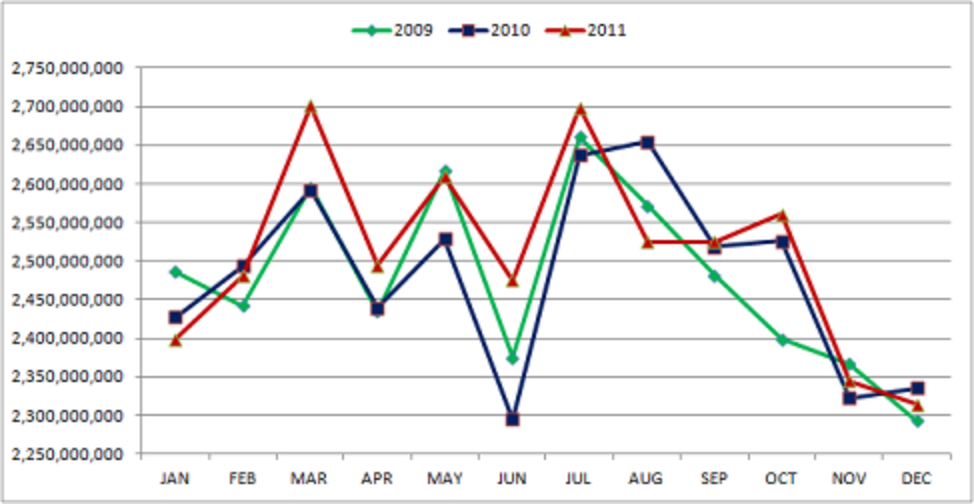
Take a look at this chart… the data reported by State Gaming Commissions from across the United States shows a clear cyclical annual patterns in play based on annual life events such as tax returns, paying for Christmas gifts, and taking vacations in the summer.

You can see the same pattern across the USA for three consecutive years. March is high, June is low, July and August are high, and the fourth Quarter is low.

This analysis was created by Harvest Trends and described in 2012 by Susan Kesel, a Gaming industry executive, in an article in Gaming & Leisure Magazine.

Does this pattern still apply to your Property? Are you having a great March? Get ready for April! Or do you have a different annual cycle?

If you talk to the CFO, they will know the annual cycle because the Finance Department has to manage the cash flow throughout the year and not be impacted by this fluctuation in revenues.

And take this into consideration as you set your Casino Host Goals! This is why many goals are written as growth over the same Quarter last  year, and not as growth over the Previous Quarter.


4 Steps to Strong Coaching from Managers

Here are 4 Steps to Strong Coaching from Managers.

  • Are you a Manager? Ask yourself ‘Do I take these Steps?’ and then file this away for when you need it.
  • Are a Host or Executive? If you are a real go-getter then you are hungry for this kind of feedback. Or, if you suspect that you are on ‘thin-ice’ with your manager, then suggest these steps to get their actual opinion of you, and to engage them in proactively coaching you.

This program takes you through the detailed steps of addressing and improving performance:

Step 1 – Prepare a Clear Assessment

  • Is there a written job description that details the expectations of the job?
  • Is there a standard Annual Evaluation Form for your Property?
  • Set aside 30 minutes of quiet time to reflect on the Host’s soft skills:
    • Read through the Job Description and the Evaluation Criteria
    • Give the Host a ‘grade’ of ABC for each part of the Job Description and the Evaluation Criteria.
      • A = ‘Really good at this’
      • B = ‘Okay at this’
      • C = ‘Not good enough at this’
  • For the C’s, write down 3 specific examples of where the Host went wrong.
  • Are their written goals such as ‘Increase Theo by 10% over last quarter?”
    • If so, review the Host’s results.
    • Reflect on your assessment of the Host’s soft skills.
      • How can the Host meet/exceed their goals by working on their B’s and C’s?
  • Prepare your summary! Map out a conversation that runs like this:
    1. Here are some areas that are really strong for you!
    2. These are some areas that need improvement.
    3. So we have talked about your strengths, and some areas that you need to improve, and I am here for you. Moving forward, how about we do X and Y each month.

Step 2 – Set up a Meeting but Don’t Terrify Them!

Schedule an hour with the Host.

Make sure your email gives them some homework to do ahead of time, so they can sit and reflect beforehand.

  • Subject “Discuss your Results”
  • Hi Jackie, Let’s spend some time going over your Job Description (attached) and discuss what you do well, and where you could improve. This is an informal conversation to see where I can give you some pointers on how to succeed. Please read the Job Description ahead of time and think about what you do really well (A), what you do adequately (B), and where you think you can improve (C). You won’t be giving me your own score but I want you to have thought ahead of time about what you see as your strengths and your areas for improvement. PS. Great job on the event last night. Thanks!

Try not to freak them out with your email! You don’t want them to lose productivity as they fret about the meeting.

Step 3 – Meet and follow the Sandwich Method

Meet with the Host in calm quiet place, and run the meeting as the Sandwich Method.

What is the 3-step Sandwich Method for giving feedback?

  1. Start with something positive (bread)
  2. Cover the negatives (the meat!)
  3. Close with encouraging words (more bread)

Sometimes, managers will describe the bread as fluff, but it really isn’t.

To stay motivated, the Host needs to know where they are strong (first slice of bread), their challenges (the meat), and that you still believe in them (last slice of bread).

(Of course, you might be at the point where you don’t still believe in them! In which case, look further down at Corrective Action.)

You run through the conversation that you prepared earlier:

  1. Here are some areas that are really strong for you! (The A’s)
  2. These are some areas that need improvement. (The C’s)
  3. and, we have talked about your strengths, and some areas that you need to improve, and I am here for you. Moving forward, how about we discuss this when we meet each month?

‘As you cover each Job Skill, do not ask them what grade they gave themselves! That was just an exercise to get them thinking.

Describe the behavior as you see it, with a specific example.

Focus on the behavior and not what you suspect to be the reason:

  • You don’t talk to as many guests as necessary. Not – I think you’re scared/lazy/too busy with your phone.
  • Your appearance needs to improve with a sharper image. Not – I think you’re scruffy, and without taste in clothes.

Don’t ask them to agree to your assessment!

  • They don’t have to agree with you, they just have to listen carefully and then take steps to meet your expectations.
  • If they say, “Well, I don’t see it that way…‘, you say ‘The point here is that I see it this way, so you are going to have to work to change my perception“.

Finally, give the Host something in writing that summarizes the C’s. This can be as simple as this:

  • Jackie, we met on 3/19 to discuss your performance. I have asked you to focus on the following:
    • Make sure you talk to 40 guests a week.
    • Improve your image to be sharper and in line with the rest of the team.
    • Focus on 10 Inactive players to get them back on property.

Ask them to sign your copy, and put it in your folder.

Schedule another meeting in a month’s time to discuss their improvement.

Step 4 – Monitor and give Feedback

For the next 30-60 days, depending on how urgent the situation is, you monitor their behavior, and note specific examples.

  • Send ‘atta-boys’ for positive change. “Hey! Just a quick note to say congratulations on meeting your goals this week”
  • And send ‘Nahs’!  “Hey, we talked about your appearance and I was not impressed when I see your tie undone yesterday”.

I know from experience that it can seem like a large investment in time to meet regularly with each team member and go through this kind of process. But if you don’t, and you just wait until the Annual Review, then:

  1. You are at risk of the employee saying the dreaded words ‘This is new to me!  You’ve never mentioned it! How can you ding me for something that you never told me! I am going to HR”.
  2. Plus! One of your key roles as a manager, is to coach and grow your team.

Are You ‘Done” with this person?

If you ‘done’ with this person, then it is time to meet with your HR representative and find out the process for “Corrective Action” which usually includes verbal warnings, written warnings, and then dismissal.

If your Property doesn’t have a Correction Action process then consider the following steps so that you can protect yourself against a charge of unfair dismissal. You can also Google for Correction Action Process. Consult with your manager and make sure they are aware of what you are doing, and support your actions.

Make sure everything is written down, or in a printed email, and put into a physical folder along with dates.

Give verbal warnings such as ‘We have discussed your appearance. It is is not acceptable and you must improve it within 30 days or you risk disciplinary action that could result in termination’. Hand-write a note for your file that captures what you said, the date, the rough time, and the location. And what the employee said, if anything.

If the change is insufficient, then put the same words into writing. ‘We have discussed your appearance. I gave you a verbal warning on 3/19. I am now giving you a written warning that this is not acceptable and you must improve it within 10 days or you risk disciplinary action that could result in termination’.

And then, if the time comes, you are well-prepared to justify the termination, and you can feel good that you did everything that you could to help the employee.

In summary, your role as the manager is:

  • Be crystal clear about your expectations and whether they are being met.
  • Give the person a chance to change and succeed by being clear, being consistent, giving specifics, and providing immediate feedback.
  • Grow the talent that is on Property

And, not incur the expense of constantly bringing in new people, training them up on your Club and Amenities, and then moving them on because they did not ‘cut it’.

As always, let Jackie know if you have anything to add to this!


****

Sign up to receive an email each week with the latest article. No Ads! Never any Ads! Just a helpful article each week about Casino Player Development.

Congratulations! Here’s how to be a Host

So you’re a casino host.  Now what?

There are tasks and goals and guests and procedures, and some of them seem to be at odds with one another.  Simply put, it’s a host’s job to balance all these things.

Your primary objective is to drive more trips or get more play from the best players at your property.  The tasks and goals and guests and procedures are all parts of the whole role, which is to build relationships with players on behalf of your property in order to secure their loyalty and limit the amount of their gaming wallet that goes to your competitors.

As a rule, the relationships you build with your players will become second nature after a time.  They may begin to feel like your actual friendships.  You’ll learn which of your players are interested in what sort of events at your casino.  You’ll figure out which ones want more comps than their play warrants (manage them carefully!) and which ones would rather just be left alone to play.  It won’t take you long to remember what brand of smokes your best players prefer, and which restaurants each of your better players frequent.  Who golfs, who owns his own business, who takes care of their grandchildren on weekends, who gets all worked up if you don’t return their call within a couple of hours…you get the idea.

But you have to start somewhere.  Begin with a letter to any “new” players, meaning ones you haven’t yet met face-to-face.  After a few days, give each guest a call to inquire whether they’ve received your letter and whether there is any service that you may offer to them.  Have a calendar or list of upcoming events handy so you can tell them what’s going on, and note the events in which they seem interested.  (That way, you know which ones to contact them for in the future.)  Explain the services you can provide and ensure that the guest knows how to reach you when they need you. As a host, it’s your responsibility to provide the guest a touchpoint for your casino.

As a player’s host, you are his “inside man.”  You should be able to get him a room or dinner reservations or show tickets or registration for a tournament or other event without him having to do more than ask you to take care of it.  Afterward, relentless follow-up is required.  Always return a guest’s call as soon as humanly possible and always do what you say you will do.  If you’re making reservations, call back with confirmation that the task is complete, no matter whether the reservation is for today or in three weeks.

Work within the guidelines you’ve been provided, and remember that when you break a rule for a guest, you are, in fact creating a new rule.  Players will share with one another what you’ve done for them, and others will begin to expect the same sort of consideration.  Be diplomatic, and learn to say “no” and make it sound like “yes,” using the phrase, “what I CAN do for you is…”  It’s never a good idea to create an expectation for something you can’t deliver.

Learn how to read player accounts well enough to quickly determine whether a guest will still be profitable after redeeming all his or her offers before providing additional incentives.  If she redeems her room and meal coupons, downloads all her points for free play AND you give her a comp, how much of her play is left over as profit?  Let that be your guide.  As a general rule of thumb, don’t comp someone more than 10% of their average theo (or loss, if that’s a bigger dollar amount.)  When you DO provide an extra incentive to a guest, be sure they understand whether or not such an incentive may be provided again in the future.  Tell them what they need to do to get what they want.

Ask the other hosts on your team (particularly those who are more experienced) how they handle certain situations and take the best practices from among them to make your own.  Every host is different in some ways from his or her counterparts, and because of that, your own signature approach will often serve you well.  Learn from your mistakes and always ask someone you trust for help when you need it.

Remember always that your job is to get more visits or more play from the best players at your casino. The best hosts find a way to accommodate their guests without creating unrealistic expectations, learn to anticipate their guests’ needs, and accurately report on their activities so the property’s leadership understands the Player Development team’s contribution to the bottom line. The tasks and goals and guests and procedures are how you get there.

And have fun with your new role!


Job Descriptions for Player Development

Here is a list of the most basic and important responsibilities in Player Development.

Feel free to copy, paste, and use these ideas in the Job Descriptions for your Player Development team. If we are missing anything, drop an email to jparker@harvesttrends.com

Summary of Responsibilities

The main responsibility of a Player Development professional, regardless of title, is to develop and maintain effective working relationships with a casino property’s very best players and provide services to them to build player loyalty and increase the number of visits or amount played (or both) from among those guests.

In order to do this, a PD pro must also develop and maintain strong working relationships with key allies throughout the property and in the community to ensure players have the experience they expect while gaming and to generate leads for new business.

Job Description for Casino Host, Executive Host, Player Development Executive

Here are the basic job functions in for everyone in Player Development (not necessarily in order of importance):

  • Establish and maintain positive customer relationships with players who meet property criteria (and with those identified to have the potential to reach that level of play)
  • Maintain contact with coded players as appropriate to generate return visits and provide exemplary service.
  • Interact with players in person on property, as well as via telephone, e-mail, text message, and written correspondence
  • Represent the property as a role model of customer service and professionalism
  • Effectively use out-bound phone-calls to keep contact with players that have not visited the property, and to market VIP parties and events.
  • Network among coded players to build relationships among the best customers and to generate leads for new high-worth players
  • Learn about and tailor services to guests’ preferences, likes and dislikes
  • Resolve player issues, whether real or perceived, to the guest’s satisfaction
  • Find the right balance in every situation between the guest’s desires and the property’s rules, regulations and guidelines  (There is always a way.)
  • Invite players to events, tournaments, shows, etc.,  according to their interests
  • Make hotel, show, dining and other reservations and communicate same to guest
  • Issue complimentaries or other offers to guests as play and property guidelines warrant
  • Host special events, player parties, property promotions and other activities as needed
  • Provide information to team and property leadership related to guest feedback, suggestions, concerns or issues
  • Maintain confidentiality of information about both customers and property; share carefully
  • Participate in brainstorming and planning sessions for Player Development program
  • Prepare and submit reports on activities as directed, complete and on time
  • Strive to achieve and exceed goals and metrics/objectives

Job Description for Player Development Manager

A Player Development Manager has 5 main responsibilities:

  • Grow the business; set and monitor achievement of goals and metrics for the team in alignment with the property’s business objectives.
  • Regularly review and re-code the players to focus the PD team on the highest potential.
  • Coach the hosts on how to improve their skills, grow their business, and meet their goals.
  • Resolve guest issues when they have to be escalated to management.
  • Manage the team, the budget, the reporting, and the logistics of events.

If you are a Player Development Manager (or other team leader) you are responsible for:

  • Setting SMART Goals and metrics for each host and for the team  (with a stretch!)
  • Monitoring pace toward goal achievement
  • Analysis of coded and potential high-worth player data
  • Assigning/coding players to hosts
  • Coaching staff as needed
  • Regular and consistent communication with all direct reports
  • Preparing and submitting activity and departmental reports as assigned
  • Attending meetings as a representative of the Player Development team
  • Participating in brainstorming and planning sessions for marketing
  • Implementing programs, events, promotions, etc. for the Player Development team
  • Providing assistance for marketing events as required
  • Resolving player issues, real or perceived, when host is unable to do so
  • Setting an example of excellent customer service

10 Traits of Successful Hosts

Being a good casino host takes a lot of varied skills.

    • You have to be a god communicator, both written and verbal.
    • You have to quickly weigh circumstances and crunch numbers to make decisions, the results of which your players will take personally.
    • You have to develop real working relationships with people around the casino to help you meet your guests’ needs in addition to the relationships you’ll need to build with the guests themselves.
    • You have to be ever mindful of the policies, procedures, regulatory concerns, ethical considerations and other guidelines by which you have to conduct your business.
    • You have to think like an entrepreneur, to develop your book of business, while abiding with your casino’s rules for reinvestment.

Here are Ten Traits that will help you to succeed:

  1. Understand what your customer want – and Share The Knowledge! Think for a moment about the things you hear over and over again in conversations with your players.  These are common themes, and it’s likely that your players have discussed their feelings about your program with one another as well. Are they getting more free play from your competitors?  Since there’s not much you can do about that, remind them that you provide them extra “value” for their visits by making it easier for them to make room or dinner reservations.  Do they tell you that they don’t like your promotions?  Get specifics and pass them along to the pertinent associates in your marketing department in order to provide those folks the direction they need to make those promotions more appealing. Share what you learn in order to keep your casino ahead of the curve.
  2. Know how to say “no” and make it sound like “yes.”  This concept suggests that you can share with them what they need to do in order to get what they want.  Rather than shut them down as soon as they ask for something not warranted by their play, tell them how much they’ll have to play in order to earn the thing they want.  Remember to look at spouse play or other mitigating factors (how frequently they customarily visit, whether they likely visit competitor properties, recent illnesses or bad weather, etc.) in your calculations.  Then tell them how many points or trips or comps they will have to earn (or make) to qualify.  Put the ball back in the player’s court, so to speak, and then the “no” doesn’t have to be spoken.  Empower the guest to earn what’s necessary to have their wish fulfilled.
  3. Understand how your property’s direct mail program works.  This single accomplishment will enable you to more profitably manage your player list.  If the guest has hotel coupons that haven’t yet been redeemed, offer to make the reservation for them using the coupon.  (If your property requires that the actual coupon be surrendered upon check-in, remind the guest to bring it to the hotel desk.)  Understanding your mail program helps you better address player concerns when their offers change, too.  And you’ll get that question a lot.
  4. Don’t over invest. When the guest asks for a steakhouse reservation, look at their offers and determine whether they want this meal in addition to what their coupons provide and decide if the comp is warranted on top of the other offers they might redeem during the trip.  If they’ve got an offer for 2 (two) show tickets and they want 4 (four) seats for an upcoming show, look at recent play to see if the add-on is warranted.  (Maybe they had a big loss since the offers mailer…or maybe they didn’t.)
  5. Make breaking (or bending) a rule a last resort.  Once you’ve broken a rule to accommodate a guest’s wishes, you’ve actually established a new rule.  The guest will likely come to expect a similar accommodation in the future unless you tactfully communicate to him that this is a one-time only situation.  As other players hear about the special favor you’ve done (and they will!), some of them are likely to ask you for similar consideration due to their own extenuating circumstances.  It can be a slippery slope, so it’s probably best to avoid the trip down the hill.
  6. Pass along player comments to your team leader.  Whether you know it or not, your team leader is probably going to follow up on the information you share.  Often, managers and directors are so busy with the day-to-day tasks of their own jobs, as well as the occasional firefight, that they don’t get to talk with guests and learn what is important or vexing to them.  In your role as a host, players will often share their frustrations or delights with you.  Close the feedback loop by sharing this information with your boss in order to ensure the guests concerns are at least within his awareness.
  7. Always maintain confidentiality.  It may seem like a no-brainer, but it’s easy to forget who is around you when you are speaking with co-workers or even other guests.  If you are going to be talking about specific player patterns or proprietary company information, always ensure you are in an area away from guests as well as employees who do not have access to the information you are sharing.  Never reveal things like ADT ranges or levels, customer losses, company policies and procedures, or sensitive information like room numbers or addresses.  When speaking with a customer directly, use generalizations or anecdotes to share pertinent information without going into specifics…unless you are talking about that guest’s own play patterns.  Even then, only use points or another metric which the customer can plainly see for himself to make your point.
  8. Never let ’em see you sweat!  Even when you’re running around the casino like a madman on a Saturday night, take your time to walk through the gaming areas, keeping in mind that the guests may take a cue from your behavior.  Walk with a purpose, but like you own the place.  Even when you’re on your way to a firefight, take advantage of opportunities to briefly “touch” players you know and make a mental note to get back to them when you have a moment.  Be calm and plan your next move instead of being buffeted by the tides of a busy casino floor.  Better yet, plan your day ahead of time.  Build in a buffer to accommodate the unexpected, and you’ll accomplish more.
  9. Don’t come out of the gate with an offer.  When you approach those players on the gaming floor, or when you reach one by phone, don’t automatically offer free play or a buffet comp.  Player development is about relationships, and it isn’t your job to be Santa Claus.  Talk with the guest.  Learn why he visits your property instead of a competitor’s.  Find out why he doesn’t like the buffet or never brings his wife with him.  Make a connection instead of an offer.  When you do this via telemarketing, you’ll often find that the overdue or inactive guest will make a visit to your property within a couple of weeks even if you didn’t sweeten the deal with something extra in the way of perks.  Just having you as their host will often keep your property top of mind, so touching base will sometimes generate a visit on its own.
  10. Never forget who you work for and who provides the dollars in your paycheck.  These entities are not one and the same.   You work for the casino, but the players provide the dollars in your paycheck.  It can create a balancing act for you, because sometimes what the player wants is at odds with what the company says you can provide.  Making sound business decisions is the hallmark of a good casino host.  Therefore, you must always balance the guest’s needs with the company’s success.  Paying a player to patronize your casino is never a good idea, because you haven’t actually secured their loyalty…and that’s ultimately what your job really is.

It’s not a job for the faint of heart!

Retaining Players – Don’t Churn, Baby, Churn”

The Importance of Avoiding Churn

If you do not measure Retention then you are at risk of enabling ‘churn’.

Churn is a term used across all industries that basically asks, “Are you busy generating new customers but losing so many existing customers that you don’t really grow?”

For example, an Executive Host acquires 20 new players during the Quarter but somehow 60 coded players slip away and do not play during the Quarter. Overall the Host is down by 40 valuable players by the end. But this won’t become visible until you measure it.

Why does this matter?

  • First, it is harder and more expensive to acquire new players than to retain existing ones. Your PD team spends more time and Comps on trying to attract or identify valuable new players, and have to invest in someone that may not become a loyal guest.
  • Second, there may be some underlying issues with guest satisfaction that you are not identifying and resolving. These were valuable enough players to be coded to a Host; so why have they declined? You need the PD team to reach out, find out what is happening, and get resolution.

So how you measure churn and give the Hosts a solid goal?

Here is a simple example of a Retention Goal. You must retain 95% of your Active Players”. If the Executive Host had 300 coded players on April 1st, then 285 of them must play at least once in April/May/June.

Why isn’t the Retention Goal set at 100%? Well, you have to make some allowance for the ‘inevitable shrinkage’ of guests moving away or  having dramatic changes in their lives.

If you think about your market, you can come up with your own logic. E.g. With 300 coded players, you might expect 2 Deaths, 10  move-aways, 1 becoming restricted, and 5 life-style changes e.g. loss of income. 2+10+1+5=18. So, you expect an inevitable shrinkage of 18. You can round it up to 20 and say the Host must retain 280 of 300 coded players.

This Retention Goal requires some support from the Database team or your Host Software provider. This is what you need at a minimum:

  • At the start of the Quarter, a list of coded players for each Host
  • At the end of the Quarter, an updated list of trips for each player on the list.
  • A way for the Host to know who has not played. This may be a weekly list from the Database team, or it may be built into your Host Software.

Advanced Retention Goals

Over time, and if you have the reporting capabilities, you might want to have a more elaborate Retention goal that uses trips and Theo to ensure the Active players are not only playing but playing at the same pace or better.

Here are two examples. The first definition ensures the Active players are not falling off in trips:

A host retains a player in a quarter if that player makes at least as many trips as in the previous quarter.

This second definition ensures the Active players are not falling off in trips and play:

A host retains a player in a quarter when that player makes at least as many trips as in the previous quarter, and total Theo is 50% or more of the total Theo in the previous quarter.

These goals have gone beyond measuring simple Retention to measuring whether Active players are ‘declining’ and the PD team is held to a higher standard.

This may be appropriate if you are in a highly competitive market, or you find yourself in competitive situation for the first time. However, this requires more sophisticated reporting from your Database team or from your Host Software vendor.

In conclusion, KISS, and keep it simple initially with something like Host must retain 280 of 300 coded players.

****

This article is published at Helpful Ideas for Casino Player Development at https://casinoplayerdevelopment.wordpress.com/ You can sign up to receive the new article each week.

2 Key Aspects of Goals; Effort and Results

When we first think about Host goals, we often think about measures and rules. For example, “a host must contact 60 people each week”, which is a measure, and “a host must not issue a comp for more than 15% of 30 day ADT”, which is a rule.

There is nothing wrong with measures and rules but a goal addresses the larger question of “what are we trying to achieve?

The Miriam Webster dictionary defines a goal as “the end to which effort is directed”.
What is the end that we are trying to achieve by having the host contact 60 people each week? Well, we are trying to make sure that the Host is busy. But busy doing what?

A cynical General Manager might suspect the Hosts are busy contacting the same 60 people that the Hosts always talks to, either because those players are pleasant or because they are demanding. Or the Player Development manager may fear the Hosts are busy talking to people that are already playing practically every day, instead of focusing on trying to get new players, or reactivate people that used to play a lot but seem to have fallen away.

It isn’t enough to measure activity, we need to write goals that measure the effort, and the success, of achieving a good outcome for the casino. We need to change the goal from measuring “the host is busy” to measuring “the host is busy doing the right things.”

After some thought, we create two goals. The first goal is “Contact 10 Inactive players each week” so the Hosts call people that haven’t played for 90 days but had high Theo when they were last playing regularly. (An organized Host will find time to call two Inactive players each day of the five-day week and 2×5=10). And the second goal is “Bring back 20 Inactive players this quarter” so the Host has to find ways to encourage the Inactive players to return.

Here are the two goals:

  • Contact 10 Inactive players each week. (Measures Effort)
  • Bring back (Reactivate) 20 Inactive players this quarter.  (Measures Result)

The first goal measures Effort; it measures whether the Host is trying to contact Inactive players. The second goal measures Results; it measures whether the Host is successful in getting those Inactive players back onto the Property.

Take another look at the Goals in place for you or your team, and see if they need a tweak?

Are they really just Measures and Rules? Or are they truly focused on rewarding Effort and Results?


Click here to read more Management Articles.

***

Available at Amazon. $21

Read this book, Casino Host Goals, and you will have a road-map for success as you create or improve your Player Development program, in the context of your Casino Marketing strategy. It belongs on the shelf of any Executive in Casino Management who wants to drive revenue from a strategic approach to PD. Just $21 from Amazon.

7 Steps For Hosts to Exceed Their Goals

No two hosts are exactly alike, and that’s a good thing. Variety among casino hosts means that any player can find a host with whom he or she can connect. It also means that each host is likely to have his or her own unique approach to working toward goal achievement.

Here is a generic approach that every host can follow to build momentum and keep the numbers growing instead of stagnating. (And if you are in Management, then you might want to introduce this approach to your team, and do some coaching.)

PRIORITIZE! Take an honest look at your goals and decide how hard they are:

  • Which goals seem more like low-hanging fruit and can be achieved most readily? Set aside a couple of hours a week on these.
  • Which goals will take the most work to achieve? Decide to spend a lot of time on these each week. An hour a day, every day, before you go out to meet guests?

Get started now on the hardest goals! A 12-week Quarter may seem like a long time but it will disappear in no time.

PLAN! Come up with an approach to each goal. This is where each Host will bring their unique ideas based on their experience and personality.

  • Is a Goal to increase Theo from Active Players by 10% over last Quarter? Perhaps you decide (1) target the highest-ADT patrons who are off pace for their usual trip pattern, and (2) target the people who were new last Quarter and could probably play-up now they know the property.
  • Is a Goal to re-activate 5 valuable Inactive players who haven’t played for six month? Maybe start by working the ones who live closest to the property? Maybe ask Direct Mail for the list of offers sent to Inactive guests and use that as the hook. Place a call and say “Hey, I’d hate for you to miss this Freeplay that you were sent. Let’s get you in to this Event next week and you can play on the House”.

If you are new to this approach, then ask your Manager and more experienced peers for some suggestions.

CLASSIFY! You’re going to be more successful if you focus on the right players at the right time. That’s easier to do if you know which of your players is the right one to call for each Goal. How do you do this?

  • Break player lists down into smaller groups so you can work more methodically.
  • Choose a set of criteria which matches your priorities. It doesn’t have to be complicated. Maybe you should work on “Players within 50 miles” or “Guests who haven’t been here in 31+ days” or “Ones I haven’t met yet.”
  • If you don’t have a Host system, then put all the names into MS Excel and start to track when you last spoke to them. You can start by asking Database for a list of your players and their City/State, and when they last played.
  • If you find you don’t know much about a particular bunch of patrons, put them in the category of ‘Don’t Know’ and start making calls to ask questions and fill in the blanks about those players.

DISCIPLINE! Create a plan and stick to as best you can. Perhaps this is your plan when you first come on shift: (1) Make a list of 5 Inactive players to call right now. (2) Make a list of 10 Active players to call during the shift. (3) Carry this list around with you and make phone-calls between dealing with guests, or while you are standing around waiting for the Entertainer to show up. Be prepared and then you can maximize your time.

MEASURE! Understanding progress is key to keeping yourself on track. If what you’re doing isn’t working, wouldn’t you rather know early on so you have time to change tactics before the goal period ends?

  • Break your quarterly goal up into 12 weeks. If you have to re-activate 24 Inactive guests then you need 24/12 = 2 guests per week, coming back and playing. If you need to grow Theo by 240,000 per quarter then it needs to grow by 240,000/12 = 20,000 per week.
  • Database might agree to pull a weekly or monthly list for you that shows who played and their Theo this quarter. If this is hard to get for yourself then give a specific example to the PD Manager of what would help the team, and ask them to approach Database.
  • Some systems can tell you on a Daily basis whether your patrons played enough to keep your numbers on pace or whether an additional push might be necessary to achieve the goal for increasing Theo etc.

With this knowledge, you can make adjustments to call patterns, prospecting plans, or events bookings to bring the numbers back in line.

REFLECT! Whether a particular goal period was successful or not, you should take some time at the end of the Quarter, to think about what worked and what didn’t,

This is the time when all the variables need to be assessed:

  • Was weather a factor? Then maybe do a snow day special that gives patrons a premium for coming in within 7 days of the crappy weather.
  • Did a high number of valuable guests just not play? Maybe a personalized handwritten letter with a special offer is the way to go.
  • Are you having trouble getting prospects coded? Perhaps it’s time to rethink how you choose prospects…or it’s time to talk to your team leader about how to qualify them for becoming coded players.

DON’T GIVE UP!!! Be honest with yourself about what you did and didn’t do well. Improve your plans, your lists, and your approach. Talk to others on your team and to Management. Perhaps reach out to someone you know at a different, non-competitor, property and brainstorm with them about different approaches for different groups of players and goals.

Remember that there is rarely a single factor that dictates success or failure. Once you have a plan, it is daily persistence that works. Good luck!

You can sign up for more articles like these at Helpful Ideas About Casino Player Development at casinoplayerdevelopment.wordpress.com

****

This post is brought to you by Harvest Trends. We specialize in Player Development (PD). Please take a look at PowerHost, a solution that helps you with everything discussed here. Or contact Paul Cutler at pcutler@harvesttrends.com or call 561.860.2621  Paul will overnight you an informative package along with pricing.