Category Archives: Managing PD

Job Descriptions for Player Development

Here is a list of the most basic and important responsibilities in Player Development.

Feel free to copy, paste, and use these ideas in the Job Descriptions for your Player Development team. If we are missing anything, drop an email to jparker@harvesttrends.com

Summary of Responsibilities

The main responsibility of a Player Development professional, regardless of title, is to develop and maintain effective working relationships with a casino property’s very best players and provide services to them to build player loyalty and increase the number of visits or amount played (or both) from among those guests.

In order to do this, a PD pro must also develop and maintain strong working relationships with key allies throughout the property and in the community to ensure players have the experience they expect while gaming and to generate leads for new business.

Job Description for Casino Host, Executive Host, Player Development Executive

Here are the basic job functions in for everyone in Player Development (not necessarily in order of importance):

  • Establish and maintain positive customer relationships with players who meet property criteria (and with those identified to have the potential to reach that level of play)
  • Maintain contact with coded players as appropriate to generate return visits and provide exemplary service.
  • Interact with players in person on property, as well as via telephone, e-mail, text message, and written correspondence
  • Represent the property as a role model of customer service and professionalism
  • Effectively use out-bound phone-calls to keep contact with players that have not visited the property, and to market VIP parties and events.
  • Network among coded players to build relationships among the best customers and to generate leads for new high-worth players
  • Learn about and tailor services to guests’ preferences, likes and dislikes
  • Resolve player issues, whether real or perceived, to the guest’s satisfaction
  • Find the right balance in every situation between the guest’s desires and the property’s rules, regulations and guidelines  (There is always a way.)
  • Invite players to events, tournaments, shows, etc.,  according to their interests
  • Make hotel, show, dining and other reservations and communicate same to guest
  • Issue complimentaries or other offers to guests as play and property guidelines warrant
  • Host special events, player parties, property promotions and other activities as needed
  • Provide information to team and property leadership related to guest feedback, suggestions, concerns or issues
  • Maintain confidentiality of information about both customers and property; share carefully
  • Participate in brainstorming and planning sessions for Player Development program
  • Prepare and submit reports on activities as directed, complete and on time
  • Strive to achieve and exceed goals and metrics/objectives

Job Description for Player Development Manager

A Player Development Manager has 5 main responsibilities:

  • Grow the business; set and monitor achievement of goals and metrics for the team in alignment with the property’s business objectives.
  • Regularly review and re-code the players to focus the PD team on the highest potential.
  • Coach the hosts on how to improve their skills, grow their business, and meet their goals.
  • Resolve guest issues when they have to be escalated to management.
  • Manage the team, the budget, the reporting, and the logistics of events.

If you are a Player Development Manager (or other team leader) you are responsible for:

  • Setting SMART Goals and metrics for each host and for the team  (with a stretch!)
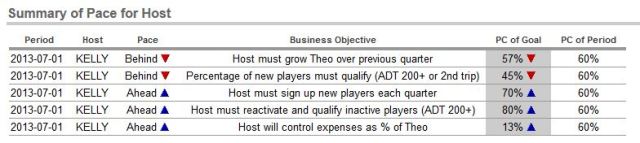
  • Monitoring pace toward goal achievement
  • Analysis of coded and potential high-worth player data
  • Assigning/coding players to hosts
  • Coaching staff as needed
  • Regular and consistent communication with all direct reports
  • Preparing and submitting activity and departmental reports as assigned
  • Attending meetings as a representative of the Player Development team
  • Participating in brainstorming and planning sessions for marketing
  • Implementing programs, events, promotions, etc. for the Player Development team
  • Providing assistance for marketing events as required
  • Resolving player issues, real or perceived, when host is unable to do so
  • Setting an example of excellent customer service

Retaining Players – Don’t Churn, Baby, Churn”

The Importance of Avoiding Churn

If you do not measure Retention then you are at risk of enabling ‘churn’.

Churn is a term used across all industries that basically asks, “Are you busy generating new customers but losing so many existing customers that you don’t really grow?”

For example, an Executive Host acquires 20 new players during the Quarter but somehow 60 coded players slip away and do not play during the Quarter. Overall the Host is down by 40 valuable players by the end. But this won’t become visible until you measure it.

Why does this matter?

  • First, it is harder and more expensive to acquire new players than to retain existing ones. Your PD team spends more time and Comps on trying to attract or identify valuable new players, and have to invest in someone that may not become a loyal guest.
  • Second, there may be some underlying issues with guest satisfaction that you are not identifying and resolving. These were valuable enough players to be coded to a Host; so why have they declined? You need the PD team to reach out, find out what is happening, and get resolution.

So how you measure churn and give the Hosts a solid goal?

Here is a simple example of a Retention Goal. You must retain 95% of your Active Players”. If the Executive Host had 300 coded players on April 1st, then 285 of them must play at least once in April/May/June.

Why isn’t the Retention Goal set at 100%? Well, you have to make some allowance for the ‘inevitable shrinkage’ of guests moving away or  having dramatic changes in their lives.

If you think about your market, you can come up with your own logic. E.g. With 300 coded players, you might expect 2 Deaths, 10  move-aways, 1 becoming restricted, and 5 life-style changes e.g. loss of income. 2+10+1+5=18. So, you expect an inevitable shrinkage of 18. You can round it up to 20 and say the Host must retain 280 of 300 coded players.

This Retention Goal requires some support from the Database team or your Host Software provider. This is what you need at a minimum:

  • At the start of the Quarter, a list of coded players for each Host
  • At the end of the Quarter, an updated list of trips for each player on the list.
  • A way for the Host to know who has not played. This may be a weekly list from the Database team, or it may be built into your Host Software.

Advanced Retention Goals

Over time, and if you have the reporting capabilities, you might want to have a more elaborate Retention goal that uses trips and Theo to ensure the Active players are not only playing but playing at the same pace or better.

Here are two examples. The first definition ensures the Active players are not falling off in trips:

A host retains a player in a quarter if that player makes at least as many trips as in the previous quarter.

This second definition ensures the Active players are not falling off in trips and play:

A host retains a player in a quarter when that player makes at least as many trips as in the previous quarter, and total Theo is 50% or more of the total Theo in the previous quarter.

These goals have gone beyond measuring simple Retention to measuring whether Active players are ‘declining’ and the PD team is held to a higher standard.

This may be appropriate if you are in a highly competitive market, or you find yourself in competitive situation for the first time. However, this requires more sophisticated reporting from your Database team or from your Host Software vendor.

In conclusion, KISS, and keep it simple initially with something like Host must retain 280 of 300 coded players.

****

This article is published at Helpful Ideas for Casino Player Development at https://casinoplayerdevelopment.wordpress.com/ You can sign up to receive the new article each week.

2 Key Aspects of Goals; Effort and Results

When we first think about Host goals, we often think about measures and rules. For example, “a host must contact 60 people each week”, which is a measure, and “a host must not issue a comp for more than 15% of 30 day ADT”, which is a rule.

There is nothing wrong with measures and rules but a goal addresses the larger question of “what are we trying to achieve?

The Miriam Webster dictionary defines a goal as “the end to which effort is directed”.
What is the end that we are trying to achieve by having the host contact 60 people each week? Well, we are trying to make sure that the Host is busy. But busy doing what?

A cynical General Manager might suspect the Hosts are busy contacting the same 60 people that the Hosts always talks to, either because those players are pleasant or because they are demanding. Or the Player Development manager may fear the Hosts are busy talking to people that are already playing practically every day, instead of focusing on trying to get new players, or reactivate people that used to play a lot but seem to have fallen away.

It isn’t enough to measure activity, we need to write goals that measure the effort, and the success, of achieving a good outcome for the casino. We need to change the goal from measuring “the host is busy” to measuring “the host is busy doing the right things.”

After some thought, we create two goals. The first goal is “Contact 10 Inactive players each week” so the Hosts call people that haven’t played for 90 days but had high Theo when they were last playing regularly. (An organized Host will find time to call two Inactive players each day of the five-day week and 2×5=10). And the second goal is “Bring back 20 Inactive players this quarter” so the Host has to find ways to encourage the Inactive players to return.

Here are the two goals:

  • Contact 10 Inactive players each week. (Measures Effort)
  • Bring back (Reactivate) 20 Inactive players this quarter.  (Measures Result)

The first goal measures Effort; it measures whether the Host is trying to contact Inactive players. The second goal measures Results; it measures whether the Host is successful in getting those Inactive players back onto the Property.

Take another look at the Goals in place for you or your team, and see if they need a tweak?

Are they really just Measures and Rules? Or are they truly focused on rewarding Effort and Results?


Click here to read more Management Articles.

***

Available at Amazon. $21

Read this book, Casino Host Goals, and you will have a road-map for success as you create or improve your Player Development program, in the context of your Casino Marketing strategy. It belongs on the shelf of any Executive in Casino Management who wants to drive revenue from a strategic approach to PD. Just $21 from Amazon.

7 Steps For Hosts to Exceed Their Goals

No two hosts are exactly alike, and that’s a good thing. Variety among casino hosts means that any player can find a host with whom he or she can connect. It also means that each host is likely to have his or her own unique approach to working toward goal achievement.

Here is a generic approach that every host can follow to build momentum and keep the numbers growing instead of stagnating. (And if you are in Management, then you might want to introduce this approach to your team, and do some coaching.)

PRIORITIZE! Take an honest look at your goals and decide how hard they are:

  • Which goals seem more like low-hanging fruit and can be achieved most readily? Set aside a couple of hours a week on these.
  • Which goals will take the most work to achieve? Decide to spend a lot of time on these each week. An hour a day, every day, before you go out to meet guests?

Get started now on the hardest goals! A 12-week Quarter may seem like a long time but it will disappear in no time.

PLAN! Come up with an approach to each goal. This is where each Host will bring their unique ideas based on their experience and personality.

  • Is a Goal to increase Theo from Active Players by 10% over last Quarter? Perhaps you decide (1) target the highest-ADT patrons who are off pace for their usual trip pattern, and (2) target the people who were new last Quarter and could probably play-up now they know the property.
  • Is a Goal to re-activate 5 valuable Inactive players who haven’t played for six month? Maybe start by working the ones who live closest to the property? Maybe ask Direct Mail for the list of offers sent to Inactive guests and use that as the hook. Place a call and say “Hey, I’d hate for you to miss this Freeplay that you were sent. Let’s get you in to this Event next week and you can play on the House”.

If you are new to this approach, then ask your Manager and more experienced peers for some suggestions.

CLASSIFY! You’re going to be more successful if you focus on the right players at the right time. That’s easier to do if you know which of your players is the right one to call for each Goal. How do you do this?

  • Break player lists down into smaller groups so you can work more methodically.
  • Choose a set of criteria which matches your priorities. It doesn’t have to be complicated. Maybe you should work on “Players within 50 miles” or “Guests who haven’t been here in 31+ days” or “Ones I haven’t met yet.”
  • If you don’t have a Host system, then put all the names into MS Excel and start to track when you last spoke to them. You can start by asking Database for a list of your players and their City/State, and when they last played.
  • If you find you don’t know much about a particular bunch of patrons, put them in the category of ‘Don’t Know’ and start making calls to ask questions and fill in the blanks about those players.

DISCIPLINE! Create a plan and stick to as best you can. Perhaps this is your plan when you first come on shift: (1) Make a list of 5 Inactive players to call right now. (2) Make a list of 10 Active players to call during the shift. (3) Carry this list around with you and make phone-calls between dealing with guests, or while you are standing around waiting for the Entertainer to show up. Be prepared and then you can maximize your time.

MEASURE! Understanding progress is key to keeping yourself on track. If what you’re doing isn’t working, wouldn’t you rather know early on so you have time to change tactics before the goal period ends?

  • Break your quarterly goal up into 12 weeks. If you have to re-activate 24 Inactive guests then you need 24/12 = 2 guests per week, coming back and playing. If you need to grow Theo by 240,000 per quarter then it needs to grow by 240,000/12 = 20,000 per week.
  • Database might agree to pull a weekly or monthly list for you that shows who played and their Theo this quarter. If this is hard to get for yourself then give a specific example to the PD Manager of what would help the team, and ask them to approach Database.
  • Some systems can tell you on a Daily basis whether your patrons played enough to keep your numbers on pace or whether an additional push might be necessary to achieve the goal for increasing Theo etc.

With this knowledge, you can make adjustments to call patterns, prospecting plans, or events bookings to bring the numbers back in line.

REFLECT! Whether a particular goal period was successful or not, you should take some time at the end of the Quarter, to think about what worked and what didn’t,

This is the time when all the variables need to be assessed:

  • Was weather a factor? Then maybe do a snow day special that gives patrons a premium for coming in within 7 days of the crappy weather.
  • Did a high number of valuable guests just not play? Maybe a personalized handwritten letter with a special offer is the way to go.
  • Are you having trouble getting prospects coded? Perhaps it’s time to rethink how you choose prospects…or it’s time to talk to your team leader about how to qualify them for becoming coded players.

DON’T GIVE UP!!! Be honest with yourself about what you did and didn’t do well. Improve your plans, your lists, and your approach. Talk to others on your team and to Management. Perhaps reach out to someone you know at a different, non-competitor, property and brainstorm with them about different approaches for different groups of players and goals.

Remember that there is rarely a single factor that dictates success or failure. Once you have a plan, it is daily persistence that works. Good luck!

You can sign up for more articles like these at Helpful Ideas About Casino Player Development at casinoplayerdevelopment.wordpress.com

****

This post is brought to you by Harvest Trends. We specialize in Player Development (PD). Please take a look at PowerHost, a solution that helps you with everything discussed here. Or contact Paul Cutler at pcutler@harvesttrends.com or call 561.860.2621  Paul will overnight you an informative package along with pricing.

Why do casinos need player development?

I’ll bet your property sends out a lot of mail. Tons of it.  Right? I remember when I was on the seed list at my last property, and it seemed like I got a LOT of mail…and that was just the stuff from my own property!  The mailers I got from checking out the competition weren’t as numerous, since I wasn’t a high roller, but I got a pretty fair number of those, too.

There is a lot of e-mail communication, too. I get something at least once a month, even from properties I haven’t visited in some time. So I know casinos are reaching out and doing database marketing; in fact, I believe casinos do this better than many other businesses today. There’s certainly room for improvement, particularly in terms of “if this, then that” marketing, but that’s another blog post…

Casinos do a lot of things to bring players through their doors.  They post giant luxury cars onto multiple billboards, radio ads let patrons know who is going to be in the showroom soon (and more billboards sport the same message), postcards alert tier card holders there’s a continuity gift program for the upcoming holiday, and reservations agents are scheduled overtime to book the hotel once the coupons arrive in mailboxes market-wide. There’s clearly a lot going on to provide incentives for players to visit a particular casino.

Events are held, show tickets are handed out, food is served, prizes are awarded, and guests show up. So, why do casinos need player development?

Casinos need a true-to-life player development department because it can generate revenue the programs and activities above don’t get for them.  Sure, a player who has had a “pretty alright” experience at your property in the past may come in if you dangle the right prize or giveaway or food coupons at them. But to get the right ones to come in more often, there’s nothing like the personal touch.

A host can make it easier and more inviting for a player to return to a particular property than any other service you can offer.  A host can simply provide the final push a patron needs to commit to the trip your coupons got them to consider.  A host can find out whether a particular guest enjoys tournaments and invite them. A host can let them know when it looks like their favorite progressive is about to hit. A host can get them to share the tale of their bad experience and convince them to give your property another chance to get it right.

There are any number of ways to get a player to come to your casino for a visit, but there is nothing quite as effective as a casino host when it comes to bringing back players or potential worth.  These players expect more than coupons and promotions as a “reward” for their patronage.  Many of them know they are worth a lot to you and expect to be treated as such. Targeting new players who aren’t yet loyal, finding players who are at risk of defection, and reaching out to those you have already lost are cost-effective ways to boost revenue, and there’s no one better than a host to bring them back to you. A well-trained and equipped host team can drive revenue that will have a significant effect on your property’s bottom line.

If you aren’t sure where to start, or if your team needs additional tools or resources, find a PD partner who can show you how to refocus your host team and target the right potential players in your database.  You’ll be pleased with the results.


This post is brought to you by Harvest Trends. We specialize in Player Development (PD). Please take a look at PowerHost, a comprehensive way to drive revenue from your team of Casino Hosts and Player Development Executives. Or contact Paul Cutler at 561.860.2621 or pcutler@harvesttrends.com.  Paul will overnight you an informative package along with pricing.

What do I do about the underperforming hosts on my team?

When looking at your host team’s performance, no matter how often, you are looking at the same kinds of things, such as theo generated, player recency, frequency, incline or decline of play, reinvestment, exceptional comps, profitability, contacts, and events support. Hopefully you and your team can see these numbers on a regular basis so you always know how you’re doing. (You can certainly use monthly numbers to tell how well your team and the individuals on it are performing. More often is better.)

Often, the results are sort of a mixed bag. Some are ahead of pace for theoretical, but behind in reactivation or acquisition goals. Others are bringing people in, but those folks aren’t playing as expected, so the host is behind in generation of theoretical revenue. This can even happen while the property itself is performing well, depending in large part on the level of the host’s efforts.

So what can you do about it? First, check your program for opportunities to underperform. Most important of all, please give your hosts measurable goals. (It doesn’t have to be complicated, though it certainly can be.) Start with contact goals: make XX phone calls, mail XX letters, speak on the gaming floor with XX players every week. This single objective set means your expectations have been outlined and can be measured, so your hosts will know what you have assigned to them to do each day. You can, of course, give each host or the team a theoretical revenue target to reach, and/or you can set achievement numbers around separate functions such as new player acquisition, list growth, maintenance and reactivation. Setting measurable and achievable goals sends a message to the hosts to tell them how to be successful in their jobs. (This works best if you’ve aligned your team’s targets with the overall trajectory of your property’s marketing programs.)

Once you’ve set and communicated goals to the hosts, you have to measure the results in order to provide them feedback for improvement. Document everything. Have them sign the goals when they are communicated, and regularly share results in team or one-on-one meetings. Schedule these sharing sessions for two days after you receive results, whenever that is. This keeps you accountable. In the meetings, provide suggestions for ways to build relationships and follow up on opportunities, ensure they understand the guidelines and tools provided to them, and hold them accountable for their performance. This includes both praise for pacing well, achieving goals, and exceeding expectations as well as proper coaching and discipline in accordance with your property’s rules when they don’t do as well as they should.sittogether

If you’ve looked at your program and found other opportunities for your hosts to underperform, make a list and determine how you will turn things around. Do you have hosts who love to hug the usual suspects but don’t make a lot of phone calls? Communicate a specific number of hours each shift you expect them to actively make outgoing phone calls, then hold them to it. Are there hosts who spend all day on the phone but never hit the gaming floor and talk with patrons? Set a specific number of interactions to be reported to you along with the location on the gaming floor where they spoke with that guest. Do you have someone who seems as though his or heart just isn’t in it anymore? Have a frank conversation about why they have this job and come up with a plan to help them re-engage, or find a way for them to gracefully move on to greener pastures. Alternatively, you could even follow up with guests to verify that they are talking with and satisfied with their host.

Do all of you have all the tools you need to set, measure, communicate, and target goals? If not, resources are available in many forms. A number of technology partners can slice and dice the data for you and help you find the opportunities already in your database. (This is true of the entire database, not just those patrons whose play warrants a host’s attention, by the way.) Use a CRM to provide continuity of contacts, preferences and play history in an ever-changing world. Use analytics to target the right patrons, and you might even use your Casino Management System to code and track play from hosted payers. You’ll also need reporting to show how many contacts have been made, which players have been in, who redeemed what, and what that all means for your host team and your property. Mostly, you have to ensure a steady stream of information about what your hosts and their players are doing in order to keep things on track and make changes when they’re not.

What are some of the specific things you can do to help an underperforming host do a better job? The first thing to do is ensure understanding of the tasks and responsibilities of the role. Start on the same page and check in regularly to stay there. Then, once a week or more, make quick notes about the hosts’ performance. It only needs to be a couple of sentences, but note things like whether you saw her going over and above, if his milestones are consistently being reached or not, and add your thoughts on the numbers in the goal period to date. This is also a good place to compile tardiness, absences or extra work hours, patron feedback you’ve received, time management concerns, strengths or weaknesses (and how they’ve progressed or not), and other measurable data specific to that host’s performance. Then once a month, sit down with each host and share your thoughts on the work history you’ve now compiled over the course of the last few weeks. Doing this ensures you are looking at the data and providing the hosts with the necessary feedback, coaching and support they need to be more successful.

When you’ve done all this and the host just isn’t achieving all he should, it’s time to have another frank conversation about the host’s future. It’s critical, especially at this stage and in this situation, that you document everything. Have the host sign documentation related to your expectations, any special arrangements you have agreed upon, milestones and dates for follow-up, and all the steps that have been taken by both of you to rectify the situation to date. Then keep detailed notes along the way. If expectations aren’t being met after all this, it is probably time to make a change.

It’s never easy to let someone go, but when it opens the door for another person who really wants to do the job, it is likely to make the team stronger in the long run. The effects of having a coworker who isn’t pulling his weight can be devastating to your team. Resentment, rumors, and a general malaise can set in and undermine everything you need your host team to be: courteous to a fault, responsive, and cooperative. Hosts who are frustrated with a co-worker are stuck in what they see as a no-win situation. It’s tough to stay motivated and present a happy face to your guests when you’re feelings about work are uncharitable. Whatever the specific issue, the hosts who are performing will appreciate that you held an underperformer accountable and those who are on the fence will understand that you expect performance at a higher level.

What if you could build and measure your DREAM PD Program?

Have you ever taken the time to sit back and really daydream about what you would do in your PD program if there were no constraints? If you could have the answer to any question you have about your host team’s work, their player lists, their productivity, and what the team is actually doing for your bottom line, what would you build?

Having spent nearly 18 years in Casino Player Development, working as an ambassador, host, promotions administrator, tournament official, club manager, and finally director of many things marketing, I know “the struggle is real”. I remember having to practically beg the database guy to run a list for me, then I’d have to spend hours combing through it to kick out the one-trip wonders,remove the folks I knew had passed away since the last list build, plus I had to try to remember which players had relationships with which host…AAAAAHHHHHH!!!!

The best marketer I ever worked for challenged me to run my PD program based on what the analysis told me. And while I certainly saw the sense in the suggestion, I had no way to truly analyse the program in order to do what this challenge laid out. We had two database gurus, and they were always too busy to help me. Director or not, my requests always ended up in line behind (all things) direct mail, promotion analysis, ad hoc reports requested by finance or the GM, and nearly everything else these busy guys did every day. Without the occasional fulfilled request for something I could update and run for myself (usually excel riddled with macros and connected to a backup database so we didn’t take down the casino floor by running a report), I was flying nearly blind and spending an inordinate amount of time trying to get answers to my many questions.

But that was then: olden times, as the youngsters say. (You know, before phones were handheld computers…) Now things are different.

What if you could easily ensure that the players coded to your hosts were worthy of that honor? Then, what if you could determine how many other players were in need of a host’s service and could round-robin assign them with a few clicks or by sending an e-mail?

What if you could set daily or weekly tasks that rolled up into monthly or quarterly goals? How about being able to see some progress to goals in real time, and getting a full update every single day? What would you think if the hosts received the same update every day so they could self-correct and make adjustments to achieve their goals in a proactive way?

What if someone told you that all of this (and more) are possible without the need to ask your IT or database teams for assistance every time you have a question? What if you could find these answers for yourself with just a few clicks?

What if your hosts could enter a player contact on the fly or update preferences while they are on the phone so you could personalize the offers that go out to your best and most loyal patrons? Better yet, what if you could see in real time how your hosts are progressing to achieving the goals and objectives you’ve assigned to them?

Wanna hear the best part? You can have all this (and more!) without having to purchase expensive hardware or software. It’s a service that can be completely automated, and it’s available for an affordable monthly fee per user. We’re talking hundreds, not many thousands of dollars. Plus, there’s no contractual obligation, no long-term commitment, and no risk.

It is possible to build the Player Development program of your dreams. It’s also possible to monitor, measure and report on the results of that program.

How does a casino host find good players?

When I started my gaming career, I was first hired as a casino host. In those days, we mostly walked around the gaming floor looking for quality players we could sign up for the players club and chatted up the guests in the high limit areas. Later, when we began mining the database to identify better players and assign them to the hosts, the Player Development function turned into more of a phone-based activity. The evolution of the Player Development program is still going strong, and I believe we need to land somewhere in the middle of these two activity types in order to be most effective.

Today, many casino hosts have lists provided to them by the database team, so they work their way through phone calls and mailing lists, often never meeting their players in person until they’ve communicated a handful of times. Some hosts have worked in PD for a number of years and have developed their own “book of business” – hard-won high-level players who call when they want to gamble. A handful of these hosts are independent operators, who can send their players to any number of casinos instead of representing just one property. It is my belief that any good casino host will understand (or seek to learn) how to “cut in” to a good player, establish a rapport, and move away from dependency on the database team to build his or her book of business.

So, how does that work? How will I find these mythical “good players”? How will I know whether they’re really worth my time? I have provided a few of the best places to look below.

  1. Go to the busiest slots areas on the gaming floor and talk with the players there.  See who has your property’s highest players club tier, watch the action as you visit, take some names and look those folks up to see how consistently they play well.
  2. Talk to the slot attendants and see who they recommend you meet.  They’re not always right, but they know who sits at a machine feeding it all day and they can tell you who you missed.
  3. Make friends with table games shift/floor supervisors.  They can quickly tell you who bought in for big money and where those players are now if they’re still in house.  Want to know who blew a lot of cash in a hurry?  Because these important and busy employees have to do the paperwork related to the biggest losers, they should be able to at least give you a name.
  4. Ask your guests for leads.  Birds of a feather do flock together, so talk to your best players and give them incentives to invite their gambling friends to your property.  Buying a round of buffets for 4 doesn’t cost very much and it makes your current player look important to their friends.  If the play is good enough, make it the steakhouse instead…and everybody shines.
  5. Learn what affinity groups are near your property and find ways to introduce yourself.  Do you host mostly table games players?  Hit the links and distribute your business cards, because many golfers also love to play casino table games.  Do you mostly handle slot players?  Find the local bingo parlor and grab a dauber, because you can learn which bingo enthusiasts go to what property while you play.  Do you have lots of guests from one particular ethnic group?  Do some research and find the community gathering place for that nationality, then offer to speak or distribute casino merchandise at a get-together.

Just like any other sales function, networking is essential to the casino hosts’ ability to build a stronger list of players and/or a book of business.  Finding players with high potential can be a challenge, but developing this skill will make you a more valuable employee and help you achieve your theoretical targets.

Do you have successful tactics to add?  Please feel free to comment!

7 Keys to Evaluating a Casino Host’s Performance

As the end of the year approaches, it is time to reflect on the year past…and for many of us, it is time to begin writing evaluations. It does not have to be a daunting prospect. Two things need to be addressed, however, before we get started.

  1. Use concrete examples whenever possible to back up what you write in the evaluation.  Even if you don’t include them in the document, make note of the examples and use them when you discuss the evaluation with the host. Anecdotes help you make a point in a clear and concise manner.
  2. Nothing in the evaluation should be a surprise to the host. If you’re going to drop a bombshell on someone, this is not the right time. Be honest, but don’t be brutal.

Use the following 7 areas of performance to evaluate whether your hosts are doing well or not, and use the evaluation process as a starting point for coaching to improve the performance of those hosts who are not meeting your expectations. Rate each host in every attribute and make notes to back up each rating.

Accountability: A host who is accountable is one who takes ownership of his role and understands how it contributes to the property’s success. The accountable host handles his responsibilities and knows where he stands in terms of his performance. What negatives should you look for? “Lost” reservations, difficulty locating the host while on shift, guests who say calls were never returned, incomplete tasks, and similar dropped balls.

Contribution: An individual makes a contribution to a team by providing candid and constructive feedback to team leaders and co-workers in the spirit of continuous improvement. Did your players like the ice cream social party you had? If not, what should you have done instead? A host who is contributing to the team’s success would have shared with you what her players said about it. She also might have told you about the shortcut she found in your player tracking system and she may even have suggested coming in an hour early tomorrow to show the ambassadors how to set up for tournament registration.

Collaboration: Hosts need collaboration to be successful. From getting timely hotel reservations to setting up birthday celebrations, hosts need to establish and nurture working relationships across the enterprise to effectively meet both guest needs and property objectives. Leveraging relationships with dealers, slot attendants, steakhouse servers, reservations agents and valet attendants enables a host to provide the absolute best experience for their players. Ask the host who her go-to person is in each department on property to understand how collaborative she is.

Communication: It is of vital importance that hosts understand what needs to be shared with whom, and in what venue. Ensuring that the flow of information follows established guidelines to protect private and proprietary data is one of the most critical security concerns hosts have. Beware the over-sharer or, alternatively, the host who rarely has anything to add to a conversation.

Results: A results-oriented host is one who achieves individual and team goals the majority of the time and focuses on results instead of efforts. Here, you’re looking for a performer who can tell you whether or not he is on pace to reach a goal, how much theo his players drive on a typical Wednesday, and what he is doing to surpass his goal. A host who is not results-oriented will tell you how many people he was unable to reach when he was making calls and often offers up excuses instead of plans when he is off pace.

HostGoals

Guest Service: This seems like a no-brainer, but it needs to be addressed because of its importance to Player Development. When in front of a guest, the host should be able to focus on that guest as though he or she is the only person in the world regardless of what is going on around them. A host should always follow up on guest requests in a timely manner and should provide the same level of courtesy to his collaborators around the property. Think of more than one anecdote to back up your score in this area, because there is always room for improving one’s guest service.

Strengths and Areas for Growth: To demonstrate your understanding of each host as an individual contributor to the department, include a short list of that host’s strengths as well as areas in which there is a need for improvement. Think of it sort of like a lawyer’s closing argument. Present to the host a quick but comprehensive picture of your view to his overall performance. Doing this establishes that you have been paying attention to the host’s work and that you know him.

Now that you’ve written some scores and anecdotes for each of the attributes, set aside the evaluation. Review it in a couple of days and make any adjustments you deem necessary, then complete the review process according to your property’s practices. Keep in mind that you should be setting the example for your team, so you may want to evaluate your own performance using the same 7 attributes.  Happy evaluating!